"Many Maghrebian and Sub-Saharanian peoples are today proud of being Belgians and
to have succeeded their integration. Personally, I have been able to witness the effects of
division in my country of origin, the Democratic Republic of Congo.
We aren't ready to accept the division of the kingdom". Emmanuel Biniamu Nganga, Representative of the African Community of Belgium, quoted by
Pascal Airault, Touche pas à mon pays!, Jeune Afrique magazine, 23rd to 29th September 2007, no. 2437, page 22-23.
"La Belgique est un accident de l'histoire, une ineptie politique, une construction boiteuse? Certes, et là réside sa chance : le Belge est constitutivement à l'abri de toute illusion, qu'elle soit nationale, historique ou culturelle. À peine né, il est déjà revenu de tout. Il n'a, d'entrée de jeu, que lui-même à qui se raccrocher. Cette "nudité métaphysique", cette "exception anthropologique", ce "gain de temps existentiel" sont menacés par un phénomène retors, détestable et hautement pervers : la Belgique devient à la mode! Le Belge a pris de la bouteille, se regarde être belge et finit par singer sa propre image, forcément caricaturale, folklorique, débilitante." Laurent d'Ursel - curator.
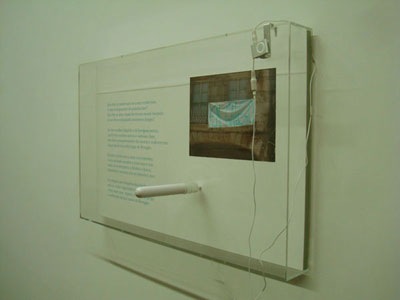
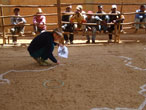
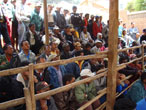
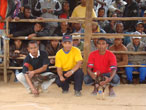
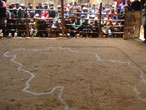
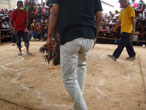
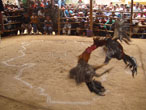
About the exhibited work: The piece was shot in the Ambatoroka neighbourhood of Antananarivo in Madagascar, where I organised a two hours cockfight in an arena chalked according to the map of Belgium in December 2007 in the midst of the 2007-2008 Belgian Political Crisis. Each protagonists and the referee were wearing the three colours of the Belgian flag and coat of arm: "Sable a lion rampant or armed and langued gules" (black, yellow and red).
The region covered by Belgium today was labelled the "cockpit of Europe" in the past (James Howell, 1640) because it has been the site of more European battles than any other country on the continent (for example: Oudenarde, Ramillies, Fontenoy, Fleurus, Jemmapes, Ligny, Quatre Bras, Ypres, Mons, Waterloo, etc).
Dan liever de lucht in (which translate in "Rather to blow up, then") are supposedly the last words of Dutch national hero Jan Van Speyk (or Van Speijk) as he blown everything altogether in a kamikaze gesture by firing a barrel of gunpowder on his boat when besieged by a mob of Belgian revolutionaries in the port of Antwerp, as they were asking him to put down the Dutch flag of his vessel on February 5th, 1831.
List of the artists: Annick Blavier, Didier Bourguignon, Maurice Boyikassé Buafomo, Marcel Broodthaers, Maxime Brygo, Pol Bury, Charles Callico, Guy Cardoso, Christian Carez, Jacques Charlier, Roby Comblain, Klaus Compagnie, Carlos da Ponte, François de Coninck, Théophile de Giraud, Raphaël de Just, Juan d'Oultremont, Laurent d'Ursel, Anne Feuillet, Yves Fleuri, Sarah Flock, Filip Francis, Arnaud Garcia, Philippe Geluck, Audrey Gérard, Noël Godin, Serge Goldwicht, Thomas Gunzig, Gaëlle Hiver, Philippe Hunt, Innuit Siniswichi, Jean Jans, Caroline Lamarche, Sophie Langohr, Jacques Lennep, Thierry Lenoir, Docteur Lichic, Daniel Locus, Emilio Lopez-Menchero, Michel Loriaux, Xavier Löwenthal, Axelle Marick, Marcel Mariën, Marie-France & Patricia Martin, Julie Martineau, Pierre Mertens, Violaine Meurens, Pierre Monjaret, Johan Muyle, Lieven Nollet, Marie-Françoise Plissart, Gwendoline Robin, Patrick Roegiers, Chéri Samba, André Stas, Cédric Stevens, Vincent Strebell, Jean-Marie Stroobants, Hélène Taquet, TupperWavre, Johan Van Geluwe, Eric Van Hove, Patrick van Roy, Wauthier van Steenberghe, David Vrancken, Alexandre Wajnberg.
Curated by Laurent d'Ursel.
"I learnt all the words worthy of the court of blood
So that I could break the rule.
I learnt all the words and broke them up
To make a single word: Homeland". Mahmoud Darwish, excerpt from I come from there.
"Palestinians in East Jerusalem, often the city of their birth, are not considered citizens but immigrants with "permanent resident" status, which, some have found, is anything but permanent. In the old South Africa, a large part of the black population was treated not as citizens of the cities and townships they were born into but of a distant homeland many had never visited. "Israel treats Palestinian residents of East Jerusalem as immigrants, who live in their homes at the beneficence of the authorities and not by right," says B'Tselem. "The authorities maintain this policy although these Palestinians were born in Jerusalem, lived in the city and have no other home. Treating these Palestinians as foreigners who entered Israel is astonishing, since it was Israel that entered East Jerusalem in 1967."" Chris McGreal, World's apart, The Guardian, 6th February 2006.
"Israeli governments reserved 93% of the land - often expropriated from Arabs without compensation - for Jews through state ownership, the Jewish National Fund and the Israeli Lands Authority. In colonial and then apartheid South Africa, 87% of the land was reserved for whites. The Population Registration Act categorised South Africans according to an array of racial definitions, which, among other things, determined who would be permitted to live on the reserved land. Israel's Population Registry Act serves a similar purpose by distinguishing between nationality and citizenship. Arabs and Jews alike can be citizens, but each is assigned a separate "nationality" marked on identity cards (either spelled out or, more recently, in a numeric code), in effect determining where they are permitted to live, access to some government welfare programmes, and how they are likely to be treated by civil servants and policemen." Chris McGreal, World's apart, The Guardian, 6th February 2006.
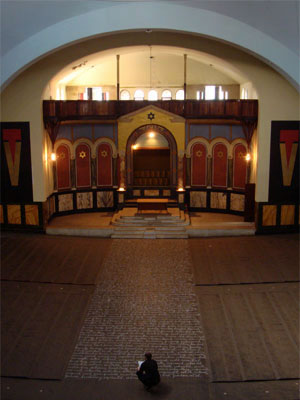
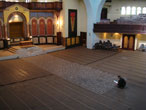
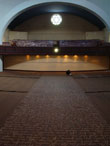
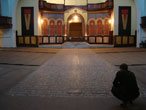
This work relates to the various and complex historic interrelations and contemporary analogies that exists between Apartheid South Africa and the State of Israel. It is based on various sources, chiefly two well-written texts titled Worlds apart and Brothers in arms - Israel's secret pact with Pretoria by Chris McGreal, published in The Guardian in 2006, echoed by Idith Zertal's "Lords of the Land" (2007). It is staged in the abandoned Great Synagogue of Wolmarans Street in Johannesburg, built in the late 19th century along the designs of the Haggia Sofia Church, an icon of Byzantium.
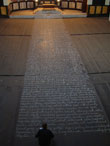
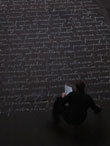
I am reminded of the passages in Edward Said's book Freud and the Non-European where he suggests that Jews and Palestinians might find commonality in their shared history of exile and dispossession, and that diaspora could become the basis of a common polity in the Middle East. Diaspora, homeland and bantustan, occupied territories, abandonment, stateless, refugees, exiles, expatriates and immigrants... Considering what seem at the crossing of terminology and topology, where lies and viewpoints often serves as self-deluding wordplays, the intervention is intended as a proof by contradiction, an apagogical argument taking the form of a list of synonyms of synonyms spanning from the word "dispossession". Using white chalk, I wrote that Reductio ad absurdum on the dark wooden floor of the deserted Synagogue, as a prayer to an abandoned authority, or a call to forsaken good-sense and forlorn sound judgment. The written list can be accessed here.
If a house of religion is a place where one faces one's truth, an abandoned house of religion is perhaps a place where one confronts one's abandoned truth.
It resulted in a silent 16:9 HD film of 124'. It was projected for the first time in the abandoned shooting range situated under the historic monument of the Drill Hall, formely a large open field known as the "Union Grounds" and used for military manoeuvres, where were imprisonned for High-treason Nelson Mandela and the 155 other leaders of the anti-apartheid liberation mouvement of the Congress Alliance between 1956 and 1961, in what was one of the most important trial of the twentieth century, instrumental in abolishing apartheid.
"Life transcends all structures, and there are new
rules of conduct for the soul. The seed sprouts
anywhere; all ideas are exotic; we wait for
enormous changes every day; we live through the
mutation of human order avidly: spring is rebellious.". Pablo Neruda
1.- The neighborhood of the Inner City of Johannesburg, around the Joubert Park area is one of the most densely populated urban sites on the continent. It is structured in a very complex fashion, halfway between playground and battleground. Ranging from the obvious to the invisible, a great number of micro territories and networks can be found, whether of ethnic, commercial, spiritual, racial, security, gender or institutional nature. Each street, or even each portions of each streets has its own laws, fashions and rules. Once in the streets, whether a shop, a car or a pedestrian, being weak for one or another reason quickly means becoming a target for one or another reason. Last but not least, the dynamics of survival in place makes locals extremely aware and attentive to any changes of mood or unknown occurrences in the public space. At the midst of all this is the object of the cellphone: simultaneously what thieves will attack you for, what enables you to call for help, what makes you reachable in case of emergency, and what connects you to your family or group; everybody has one.
In this context, the proposed project was to create a cellphone-based sms network using a free shareware downloaded from the Internet which has no territorial, commercial, ethnic or religious significance, and which only exists for itself, overlapping all other established urban categories. In what is often felt to be a "lose-lose" situation, its purpose is simply to allow for a temporary escape from the system, breakouts from the reality of a segregated established order of power, by running conceptual flash mobs custom designed for specific streets of the neighborhood, and aimed at delivering periodic, poetic or metaphoric messages to the local population. The usual lapse of time was of about 15 seconds. These sudden and punctual emergences of an unknown network, simultaneously threating and playful, aim at energizing the social urban landscape for a cause of common good.
2.- Abreaction in Johannesburg: Sort of succinct graffiti, this performance is a poetic and cathartic work of vulgarization consisting in the traversing of the public space with a single sentence of automatic writing. Abreaction, the intervention invite an exteriorisation of emotional tension, possible effect according to Aristotle of tragedy on the audience (Poetics, VI and VIII).
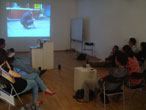
This artist talk is part of a larger series of discussions which should be considered storytelling objects. It used a number of earlier works and interventions -some unfinished or never even shown- as the base for a display of ideas and ruminations believed to be more meaningfully conveyed through stories. Maybe here the traveling contemporary artist is in some way similar to the Kamishibai of Japan who, between the two world wars, was telling from the back of his bike different stories based on a number of picture cards. We can also think of the bakhshi or Ashug of central Asia or the itinerant storytellers of africa (mikilist of the Congos, Griots of Mali, bards, ashiks, jyrau,...) who go from one village to the next, unfolding a story.
Starting from concrete examples (i.e. "Abreaction" intervention / Shanghai-2004, "A nos morts" intervention / Senegal-2005, or "Off the record" curating project / Tokyo-2006...) the talk attempted to show how the use of the "broader public space" -meaning the foreign public space- for artistic interventions pondering such ideas as statelessness or diasporism, can offer an appropriate catalyst for engaging with issues of today.
Thus this calligraphic intervention related to the Anthropometries of Yves Klein, the Logograms of Christian Dotremont and the Dactylograms of Piero Manzoni, which I have labelled a Metragram and that consists of inscribing on the hypogastrium (womb) of a woman with monochromic black ink -- tabula rasa, pinakis agraphos. A Metragram is a symbolic (perhaps cathartic) inking with a calligraphy brush of the origin of the world.
For a glimpse at other images from the Metragram series, visit this webpage.
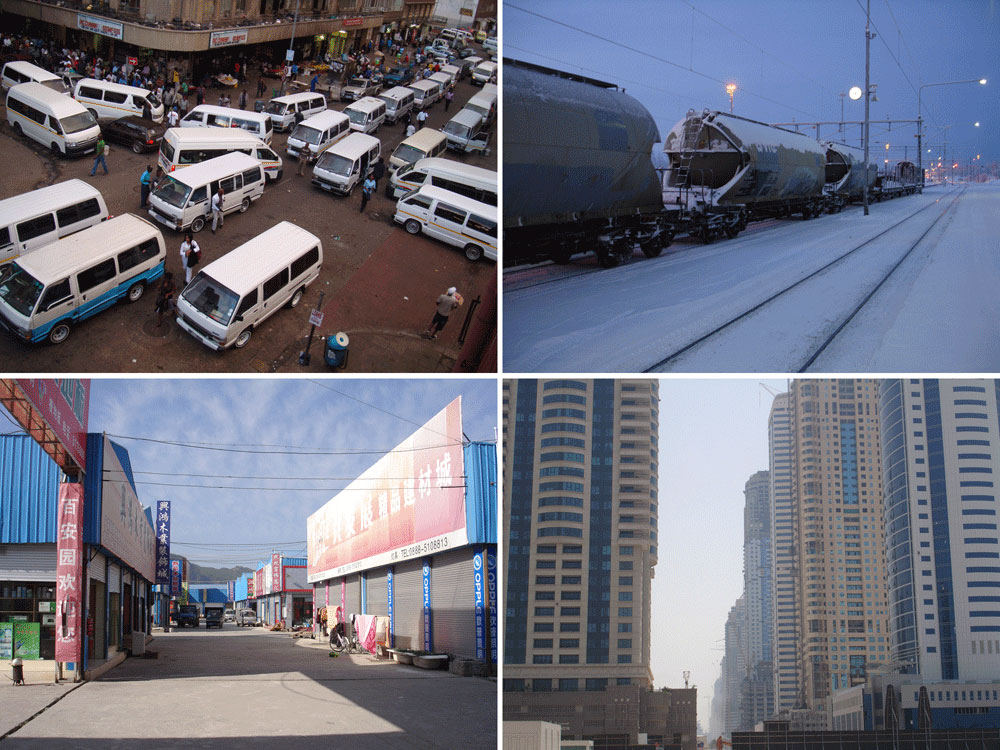
About the exhibited work: Ecumenopolis is an MJPG non-linear experimental documentary digital film of the utopian worldwide city. Previously showcased at Location 1 in New York and at De Paviljoens Museum in the Netherlands, the piece is an on going MJPG non-linear digital documentary film experimenting with cinema as an apparatus of memory, and recomposing a fictive city out of footages made in 90 cities on five continents. About 1500 low-resolution short video sequences of 5 to 15 seconds (You Tube equivalent) are randomly selected and played from a database, generating a continuous narrative ultimately bound to déjà vu. It can be seen as dealing with utopia, while slowly enabling viewers to daydream. A "video still life" of a sort, it relates to some other films' attempt to envision a city's soul, as "A propos de Nice" of Jean Vigo or "Berlin, symphony of a great city" of Walther Ruttmann. Ecumenopolis is a word invented in 1967 by the Greek city planner Constantinos Doxiadis to represent the idea that in the future urban areas and megalopolises would eventually fuse, leaving a single continuous world-wide city as a progression from the current urbanization and population growth trends.
In the writings of Yanagita Kunio, appears the figure of a palimpsestic imaginary where the earlier and essential layers of national life -- in the form of custom, practice, and belief -- were still able to filter through the modern overlays and provide a map for the present. Yanagita appealed the trope of a non-linear history of custom by employing the vivid imagery of a stalactitic formation that grows unobserved into the shape of a large icicle. This brings to mind Freud's text "Civilization and its discontents," and the dual archaeological model of Rome as the visible city of ruins and Pompeii as the lost city, buried whole. We could think of the Freudian concept of "screen memory", or Benjamin's concept of "auratic memory".
Curated by Elaroussi Moulim.
Visconti, Lettore di Proust (translated from French by Michael Fantauzzi) :
"Luchino Visconti was a great reader of "A la Recherche du Temps Perdu." While often working to bring other authors to the screen, the "cineaste of time" didn't hide his passion for Marcel Proust and his romanesque masterpiece. Many of Visconti's films, especially Il Gattopardo (1963), Vaghe stelle dell'Orsa (1965), Morte a Venezia (1971) and L'Innocente (1976), borrow from Proust's universe not only with regards to underlying intellectual themes, but also by way of explicit allusion and aesthetic. This essay examines such varied affinities, and concludes with a surprising account -- the actress Nicole Stephane reveals that in the early 70s she was set to produce for Visconti a planed adaptation of the "Recherche." Sadly, the project never came to fruition."
Peter Kravanja, Brussels, November 17th 2004.
The drawings proposed are called "Karautsushi Sketches," karautshushi being a Japanese term (空写し) that describes the act of pressing the shutter button of a camera without producing an image, either because no film is engaged, or by advancing the roll without any deliberate framing. They are made by circumscription and superimposition, the latter procedure sometimes being used cinematographically to "place an emphasis on time's flux." Circumscription, a technique that we learn from Xenephon the painter Parrhasius excelled at, consists of tracing the border of an image.
The drawings were realized using visual documents found by a search engine, by placing a sheet of paper directly over the screen of a computer connected to the internet. This method refers a posteriori to a tradition that reaches back to the Renaissance, when the monocular perspective first systemized by Leon Battista Alberti was being refined and further developed. The keywords used refers to Death in Venezia, Thomas Mann, and related fictionous and real caracters.
They were then send to the curator who had assistants realized them directly in some dead-end of the Venitian street maze.
Curated by Lino Polegato (FluxNews).
Contribution to the exhibit is a video work made in Shanghai: it is a 18' video work filmed by Australian artist Richard Thomas, documenting an installation which occured in the old Chinese city, near the Yuyuan Gardens, starting in front of the Qin Yubo Taoist temple. Curated by Jan Van Woensel.
This artist talk is part of a larger series of discussions which should be considered storytelling objects. It used a number of earlier works and interventions -some unfinished or never even shown- as the base for a display of ideas and ruminations believed to be more meaningfully conveyed through stories. Maybe here the traveling contemporary artist is in some way similar to the Kamishibai of Japan who, between the two world wars, was telling from the back of his bike different stories based on a number of picture cards. We can also think of the bakhshi or Ashug of central Asia or the itinerant storytellers of africa (mikilist of the Congos, Griots of Mali, bards, ashiks, jyrau,...) who go from one village to the next, unfolding a story.
Starting from concrete examples (i.e. "Abreaction" intervention / Shanghai-2004, "A nos morts" intervention / Senegal-2005, or "Off the record" curating project / Tokyo-2006...) the talk attempted to show how the use of the "broader public space" -meaning the foreign public space- for artistic interventions pondering such ideas as statelessness or diasporism, can offer an appropriate catalyst for engaging with issues of today.
Talk invited by Abir Boukhari, Muhammad Ali and Nisrine Boukhari.
This artist talk is part of a larger series of discussions which should be considered storytelling objects. It used a number of earlier works and interventions -some unfinished or never even shown- as the base for a display of ideas and ruminations believed to be more meaningfully conveyed through stories. Maybe here the traveling contemporary artist is in some way similar to the Kamishibai of Japan who, between the two world wars, was telling from the back of his bike different stories based on a number of picture cards. We can also think of the bakhshi or Ashug of central Asia or the itinerant storytellers of africa (mikilist of the Congos, Griots of Mali, bards, ashiks, jyrau,...) who go from one village to the next, unfolding a story.
Starting from concrete examples (i.e. "Abreaction" intervention / Shanghai-2004, "A nos morts" intervention / Senegal-2005, or "Off the record" curating project / Tokyo-2006...) the talk attempted to show how the use of the "broader public space" -meaning the foreign public space- for artistic interventions pondering such ideas as statelessness or diasporism, can offer an appropriate catalyst for engaging with issues of today.
Thus this calligraphic intervention, possibly related to the Anthropometries of Yves Klein, the Logograms of Christian Dotremont and the Dactylograms of Piero Manzoni, which I have labelled a Metragram and that consists of inscribing on the hypogastrium (womb) of a woman with monochromic black ink -- tabula rasa, pinakis agraphos. A Metragram is a symbolic (perhaps cathartic) inking with a calligraphy brush of the origin of the world.
For a glimpse at other images from the Metragram series, visit this webpage.
This artist talk is part of a larger series of discussions which should be considered storytelling objects. It used a number of earlier works and interventions -some unfinished or never even shown- as the base for a display of ideas and ruminations believed to be more meaningfully conveyed through stories. Maybe here the traveling contemporary artist is in some way similar to the Kamishibai of Japan who, between the two world wars, was telling from the back of his bike different stories based on a number of picture cards. We can also think of the bakhshi or Ashug of central Asia or the itinerant storytellers of africa (mikilist of the Congos, Griots of Mali, bards, ashiks, jyrau,...) who go from one village to the next, unfolding a story.
Starting from concrete examples (i.e. "Abreaction" intervention / Shanghai-2004, "A nos morts" intervention / Senegal-2005, or "Off the record" curating project / Tokyo-2006...) the talk attempted to show how the use of the "broader public space" -meaning the foreign public space- for artistic interventions pondering such ideas as statelessness or diasporism, can offer an appropriate catalyst for engaging with issues of today.
This artist book presents the 25 first photos of the Metragram Series, which was presented at the gallery Rossicontemporary in Brussels recently, along with the second chapter entitled "tu es venue" from the book "Poser" by Michel Assenmaker. The book presentation was accompanied by an original slideshow screening as well as a short documentary entitled Michiyuki, filmed at the end of 2008 by Azilys Romane during a dual video-talk which took place in the context of "De Avonden" organized by the Brussels independant project space établissements d'en face.
For the page specific to this artist book or for placing an order, visit this webpage.
This picture was made with Bamako based Haitian contemporary dancer Kettly Noel and dancers of he Dance Company, the Donko Seko group.
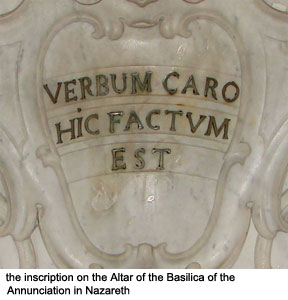
The inscription on the wall sends back to the inscription which can be found on the Altar in the Grotto of the Annunciation in the lower church of the Basilica of the Annunciation in Nazareth and reads: verbum caro hic factum est - "Here the word was made flesh". It is here used in relation to Sartre's preface to Frantz Fanon's Wretched of the Earth (French: Les Damnés de la Terre, first published 1961).
Thus this photo-calligraphic intervention, possibly related to the Anthropometries of Yves Klein, the Logograms of Christian Dotremont and the Dactylograms of Piero Manzoni, which I have labelled a Metragram and that consists of inscribing on the hypogastrium (womb) of a woman with monochromic black ink -- tabula rasa, pinakis agraphos. A Metragram is a symbolic (perhaps cathartic) inking with a calligraphy brush of the origin of the world.
For a glimpse at other photos of the Metragram series, visit this webpage.
This artist talk is part of a larger series of discussions which should be considered storytelling objects. It used a number of earlier works and interventions -some unfinished or never even shown- as the base for a display of ideas and ruminations believed to be more meaningfully conveyed through stories. Maybe here the traveling contemporary artist is in some way similar to the Kamishibai of Japan who, between the two world wars, was telling from the back of his bike different stories based on a number of picture cards. We can also think of the bakhshi or Ashug of central Asia or the itinerant storytellers of africa (mikilist of the Congos, Griots of Mali, bards, ashiks, jyrau,...) who go from one village to the next, unfolding a story.
Starting from concrete examples (i.e. "Abreaction" intervention / Shanghai-2004, "A nos morts" intervention / Senegal-2005, or "Off the record" curating project / Tokyo-2006...) the talk attempted to show how the use of the "broader public space" -meaning the foreign public space- for artistic interventions pondering such ideas as statelessness or diasporism, can offer an appropriate catalyst for engaging with issues of today.


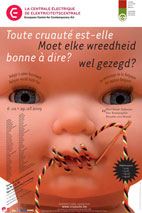 "La Belgique est un accident de l'histoire, une ineptie politique, une construction boiteuse? Certes, et là réside sa chance : le Belge est constitutivement à l'abri de toute illusion, qu'elle soit nationale, historique ou culturelle. À peine né, il est déjà revenu de tout. Il n'a, d'entrée de jeu, que lui-même à qui se raccrocher. Cette "nudité métaphysique", cette "exception anthropologique", ce "gain de temps existentiel" sont menacés par un phénomène retors, détestable et hautement pervers : la Belgique devient à la mode! Le Belge a pris de la bouteille, se regarde être belge et finit par singer sa propre image, forcément caricaturale, folklorique, débilitante." Laurent d'Ursel - curator.
 "If the day comes when the two-state solution collapses,
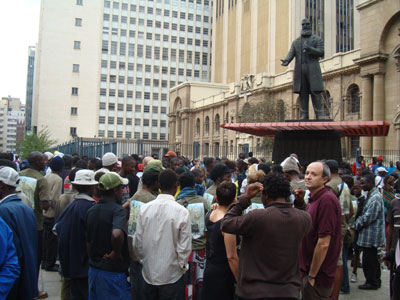 1.- The neighborhood of the Inner City of Johannesburg, around the Joubert Park area is one of the most densely populated urban sites on the continent. It is structured in a very complex fashion, halfway between playground and battleground. Ranging from the obvious to the invisible, a great number of micro territories and networks can be found, whether of ethnic, commercial, spiritual, racial, security, gender or institutional nature. Each street, or even each portions of each streets has its own laws, fashions and rules. Once in the streets, whether a shop, a car or a pedestrian, being weak for one or another reason quickly means becoming a target for one or another reason. Last but not least, the dynamics of survival in place makes locals extremely aware and attentive to any changes of mood or unknown occurrences in the public space. At the midst of all this is the object of the cellphone: simultaneously what thieves will attack you for, what enables you to call for help, what makes you reachable in case of emergency, and what connects you to your family or group; everybody has one.
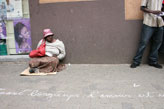
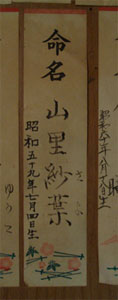 Yamazato Sayo's grand father used to inhabit this old house in the Makishi neighborhood of Naha. On the wall behind her, amoung other paraphernalia, are attached the hand-written papers he received to announce each birth in his family, among which is this of his grand-daughter.
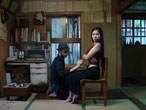
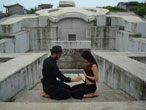
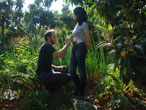
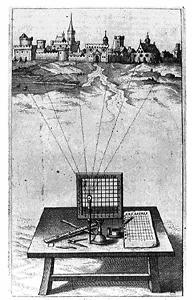
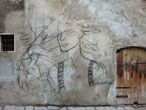
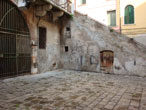
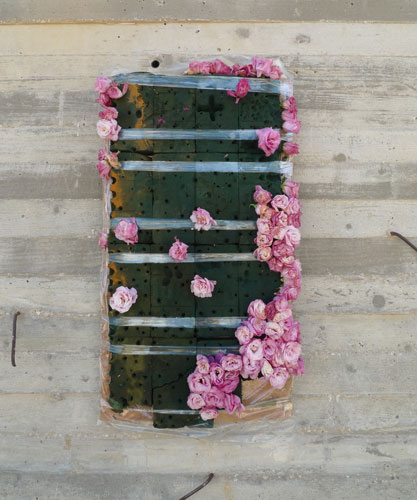
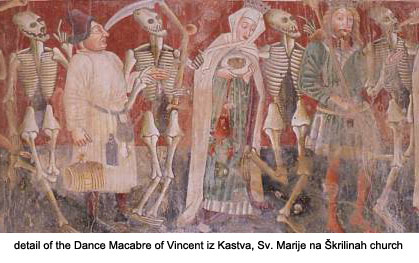 The 14th century frescoes of Vincent iz Kastva in the Sv. Marije na Škrilinah church, including a Dance Macabre appearing here at the top of this Metragram photography, is one the three most significant Istrian heritage with the Mosaic of the Basilica Eufrazijana in Porec and the amphitheatre of Vespasian in Pula. The theme of the Dance Macabre is connected with the Wheel of Fortune (Rota Fortunae, on the right in this photo around the window), the Vanity of vanities or Vanitas and the Memento Mori, referring to the capricious nature of Fate, how vain the glories of earthly life are, and the representation of the universality of death: no matter one's station in life, the dance of death unites all. The apparent class distinction in almost all of these paintings is completely neutralized by Death as the ultimate equalizer. The top fresco of the Dance Macabre might have been inspired by the Ars moriendi ("The Art of Dying"), two latin texts which appeared about 30 years before its realization.
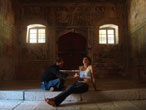
 This picture was made with Bamako based Haitian contemporary dancer Kettly Noel and dancers of he Dance Company, the Donko Seko group.
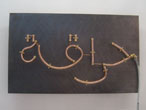
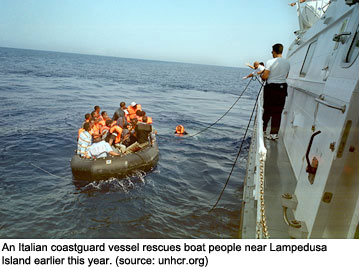 If the introduction of the event evoked "the eternal dream of mankind to belong to a world without borders" that "artists have often put into perspective, giving to see the source of the things of life", the piece I proposed reflect on the phenomenon of the ḥarrāgas, those men and women who decide to cross the Mediterranean from the Maghreb to Europe in hope of a better future, and often die crossing.
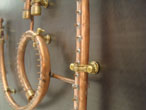
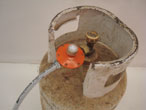
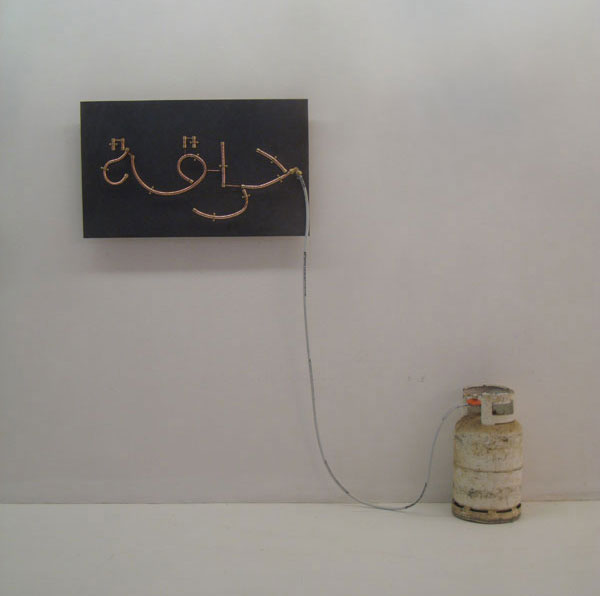
A word very often used in the Northern African press, also present in Spanish language by now, the work is a litteral illustration of the word ḥarrāga in Algerian Arabic (ﺣﺮﺍﻗـة) which means "burning" (their passport before leaving), and foster natural gas as the main National production of Algeria, simultaneously the cause and what could partly solve the problem. The piece sends back to the monument of the unknown soldier and the tradition of the eternal flame, except that it isn't here about an unknown patriot who died for a country, but an unknown victim of an apartid (stateless) era.
If the introduction of the event evoked "the eternal dream of mankind to belong to a world without borders" that "artists have often put into perspective, giving to see the source of the things of life", the piece I proposed reflect on the phenomenon of the ḥarrāgas, those men and women who decide to cross the Mediterranean from the Maghreb to Europe in hope of a better future, and often die crossing.
A word very often used in the Northern African press, also present in Spanish language by now, the work is a litteral illustration of the word ḥarrāga in Algerian Arabic (ﺣﺮﺍﻗـة) which means "burning" (their passport before leaving), and foster natural gas as the main National production of Algeria, simultaneously the cause and what could partly solve the problem. The piece sends back to the monument of the unknown soldier and the tradition of the eternal flame, except that it isn't here about an unknown patriot who died for a country, but an unknown victim of an apartid (stateless) era.